
The Sunk Cost Fallacy doesn't exist for the Vegas Golden Knights
Eight playoff appearances in nine years and a Stanley Cup. The roster building edge that keeps the Golden Knights a perennial contender


Play Do You Know Puck, The Theory of Hockey’s free daily Trivia Game at: Theoryofhockey.com/puck
Over the course of the first nine seasons of Vegas Golden Knights hockey, the team has a ludicrous .626 points percentage (4th in the NHL in that span), made the playoffs eight out of nine times and have never finished lower than 4th place in their division. For an expansion franchise, this level of success out of the gate is unprecedented.
The Golden Knights are now in the conference final for the fifth time in nine seasons.
From the very jump, the Golden Knights exceeded expectations. In their inaugural season, Vegas went all the way to the Stanley Cup final with a roster largely comprised of players overlooked by their previous teams, the group was shot out of a cannon.
The team’s foundational stars, on paper, were winger James Neal and goaltender Marc-Andre Fleury. But what allowed Vegas to thrive immediately was the emergence of pieces like Jonathan Marchessault, William Karlsson and Reilly Smith. That trio all soared to career highs and gave the organization a strong starting point.
But what sets Vegas apart from the rest of the NHL, even the contenders, is their cunning. For all of the success the Golden Knights had in year one, at no point was that viewed as being a high water mark or unexpected. If anything, it made their front office hungry for more success.
Those high expectations mean continually pushing the envelope and finding ways to improve. Unlike other NHL franchises that get caught up in sentimentality and overcommit to role players, the Golden Knights have mostly avoided those pitfalls.
Consider that of that original expansion roster from 2017-18: Jonathan Marchessault, David Perron, James Neal, William Carrier and Jon Merrill all left in free agency.
Then add in the fact that Vegas traded Reilly Smith, Ryan Reaves, Marc-Andre Fleury, Nate Schmidt, Colin Miller, Cody Eakin, Zach Whitecloud, Alex Tuch and Zach Whitecloud from the original team. 14 of the 31 skaters who played at least one game were moved on from and their value maximized.
Where Vegas thrives is maximizing value and playing leverage. Instead of waiting for prospect development or draft picks to materialize, the Golden Knights liquidate assets and pounce. Turning depth players into extra mid-round picks to load up the coffer to swing bigger trades down the road was tidy business.
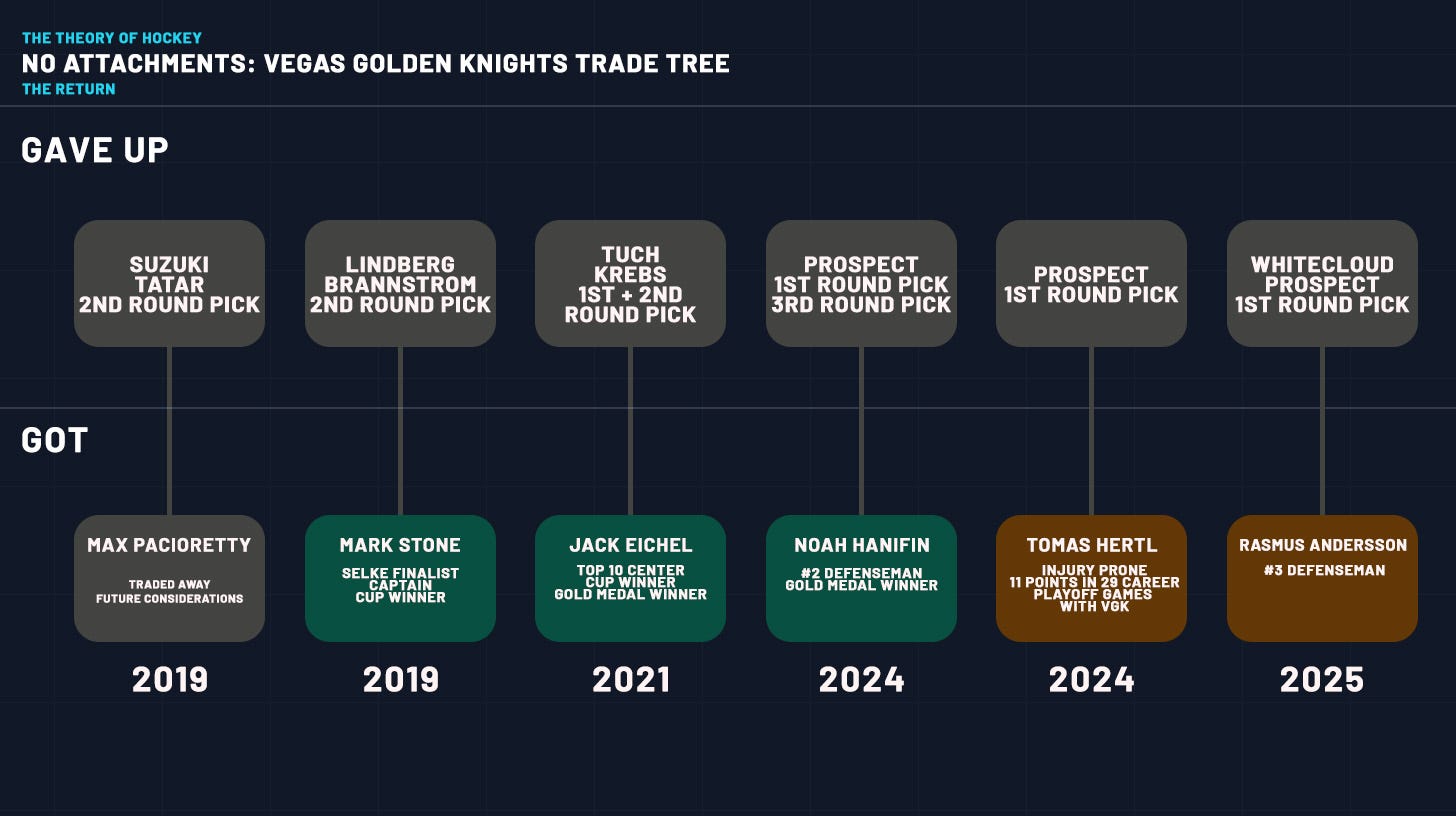
While prospects and picks present a mystery box of opportunity, the Golden Knights focus on maximizing their assets into tangible, proven returns allows for more certainty. Prospects and picks take years to reach the NHL level, already proven NHL pieces become the latest mercenary additions.
Going even deeper, what’s enabled Vegas’ to sustain contender status is an emphasis on flexibility. While many teams across the league feel they can’t afford to lose their current standing and sign depth pieces to longer term deals, the Golden Knights have avoided getting bogged down with middle and bottom six players for term.
Not tying themselves down to depth pieces at overly expensive rates enabled the team to swing on free agents like Alex Pietrangelo and Mitch Marner when the time was right. Vegas, by virtue of their persistent contender status keeps them in the mix for premium free agents in spite of how aggressive the roster churn is.
The only true money mistake on Vegas’ ledger is the Adin Hill contract. The net minder did backstop the Golden Knights to a Stanley Cup in 2023, but in the subsequent three seasons he’s failed to recapture those sustained highs. At $6.25 million per for another five years, the deal is franchise sinking, but it’s not an insignificant commitment.
Vegas bringing in goaltender Carter Hart after his role in the 2018 Team Canada WJC case reflects the levels they’re willing to stoop to. The goaltender’s professional relationship with head coach John Tortorella, from their time together in Philadelphia with the Flyers, was part of the impetus for hiring the latter with just eight regular season games remaining.
On one hand, the Golden Knights’ have showcased how to manage the salary cap era at the highest level. Trade potential for certainty, only pay for high level production and when the timing is right, swing the trade or pay the marquee free agent. Getting stuck with players who play under the value of their deal sink contenders.
At the same time, bringing Hart into the operation adds a grim sheen of desperation. Vegas has operated like the guy in your fantasy football league eager to swing moves more than win games. That’s yielded incredible results in a risk averse league where GMs operate on the margins instead of with vision.
The vision in Vegas is at the highest possible level, it’s not warm and fuzzy. Eventually, the Golden Knights will reach a tipping point where their lack of picks and prospects can’t be overcame. The organization will always be looked at with an air of derision for its people management and now bringing in Hart to try and salvage what was a meandering season.
VGK are the Cobra Kai of hockey
I love VGK’s brand of Hockey! This is an organization that takes winning seriously.